

ANUA: The Heartleaf From Ulleung Island That Changed Korean Skincare
The name takes a moment to decode. "Anua" — 아누아 in Korean — is a compound of two words: an (안), meaning safe or peaceful, and ua (우아), meaning elegant. Together they express something the brand has been delivering since its launch in 2020: skincare that is calm, uncomplicated, and quietly effective. In five years, ANUA has sold over 40 million products globally, earned the number-one toner ranking on Olive Young in 2022, and become one of the fastest-growing K-beauty brands of the decade — largely through a single plant that most people outside Korea had never heard of before.
Heartleaf: the plant from Ulleung Island at the centre of everything

Heartleaf — Houttuynia cordata — has been used in traditional Korean and East Asian medicine for centuries, primarily for its anti-inflammatory and antimicrobial properties. It appears in historical records as a treatment for respiratory conditions, skin infections, and inflammation. What ANUA recognised was that its documented anti-inflammatory mechanisms translate with unusual effectiveness to topical skincare — particularly for the kind of chronic, low-grade skin inflammation that underlies most cases of redness, sensitivity, and acne-prone congestion.
ANUA doesn't source generic heartleaf. The brand's ingredient comes specifically from Ulleung Island, a volcanic island off the east coast of Korea, where the combination of clean sea air, mineral-rich soil, and specific rainfall patterns produces heartleaf with a demonstrably higher concentration of quercitrin — the active compound responsible for the plant's anti-inflammatory and skin-regenerating effects. The difference matters: Ulleung heartleaf is larger, more potent, and more consistent in its active compound concentration than heartleaf sourced from the mainland or other regions. This isn't a marketing distinction — it's the reason ANUA products perform differently from other heartleaf-containing products on the market.
ANUA also developed a proprietary extraction process called Quercetinol, which isolates and concentrates the core active component of heartleaf to maximise its efficacy in finished formulas. This compound appears across the brand's cleansing, toning, and treatment range, and is the scientific foundation of ANUA's claim to deliver genuine skin-calming results rather than temporary surface soothing.
The Heartleaf 77% Toner — how a single product built a brand

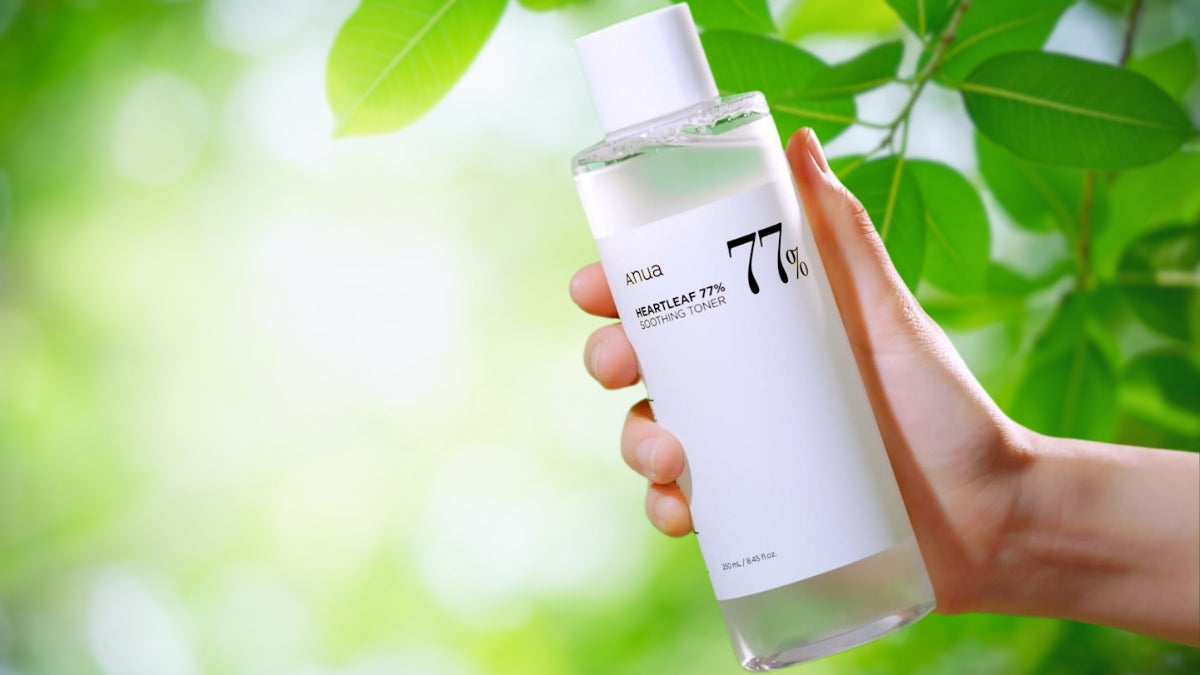
The Heartleaf 77% Soothing Toner is ANUA's most important product, and understanding why it works explains the entire brand's philosophy. The formula is structured around 77% heartleaf extract — one of the highest single-ingredient concentrations in any toner at any price point. The remaining formula is a minimal supporting cast: centella asiatica leaf water, niacinamide, and a small number of hydrating and stabilising compounds. No fragrance, no alcohol, no unnecessary actives competing for the same real estate.
The product became number one in the toner category on Olive Young — Korea's dominant beauty retail platform — in 2022, and its success spread internationally through a combination of TikTok demonstration videos and genuine user results in skincare communities on Reddit and Instagram. The pattern of growth mirrors COSRX's trajectory in the 2010s: a product with an unusually straightforward formulation achieving viral status because it actually does what it claims, at a price point that makes it accessible without requiring brand loyalty as a prior condition.
For oily and combination skin specifically, the toner addresses a problem that most hydrating toners fail to solve: delivering meaningful hydration without adding sebum-promoting heaviness. The heartleaf extract simultaneously hydrates and regulates sebum at the follicle level, while the low-pH formulation maintains the skin's acid mantle. The result is a toner that works for skin types that typically find hydrating toners either too rich or too reactive — a genuinely unusual positioning.
Peach, birch, and the rest of the ANUA ingredient universe

ANUA's range extends well beyond heartleaf, though the ingredient philosophy remains consistent: high-concentration single-source botanicals, supported by research-backed actives, in formulas with minimal unnecessary additives. The Peach 70% Niacin Serum is a good example of this approach applied to a different concern. The peach extract comes from Jeju Island — Korea's volcanic southern island, where the marine climate and alkaline sea breezes produce fruit with elevated antioxidant and brightening compounds. At 70% concentration, combined with niacinamide, the serum addresses hyperpigmentation and uneven skin tone with the same high-percentage ingredient logic as the heartleaf toner.
The Birch 70% Moisture Boosting Cream takes a different angle: rather than targeting a specific concern, it addresses the foundational need for lasting hydration in a format that works across skin types. Birch sap — the ingredient used most famously by ROUND LAB in their own line — is a naturally mineral-rich fluid that ANUA uses as a base rather than purified water, delivering amino acids, sugars, and trace minerals continuously through the moisturiser's wear time. The result is a cream that hydrates durably rather than immediately, which makes it particularly useful for skin that tends to feel replenished right after application but dehydrated again by mid-afternoon.
ANUA's PDRN range, launched more recently, brings the brand into the regenerative skincare space that has been one of K-beauty's fastest-growing categories. PDRN — polydeoxyribonucleotide, a wound-healing ingredient with documented cellular repair properties — is combined with hyaluronic acid in both a capsule mist and a moisturising cream, targeting the same demographic that has made COSRX and REJURAN's PDRN lines successful: people whose skin needs genuine repair rather than surface treatment. ANUA's formulation pairs PDRN with their established heartleaf and botanical framework, creating a product that addresses regeneration and calming simultaneously.
Why ANUA works for skin types that most K-beauty fails
The brand's most consistent praise comes from a specific profile: people with oily, acne-prone, or sensitive skin who have cycled through multiple K-beauty brands looking for hydration without heaviness, calming without fragrance, and actives without irritation. ANUA's avoidance of synthetic fragrance, alcohol denat., parabens, and sulphates is thorough rather than selective — it's not a fragrance-free product next to fragranced ones on the same shelf. The entire brand operates on a low-irritation formulation standard.
The brand also holds PETA cruelty-free certification and maintains a 100% Korea-manufactured supply chain, with minimalist packaging designed to minimise production waste. These aren't peripheral marketing points for ANUA — they're embedded in the brand's original positioning as skincare that is 'safe and elegant.' The 2025 expansion into haircare with the Heartleaf Scalp Serum and Hair Growth Elixir extends the same philosophy to a new category, applying the Ulleung Island heartleaf complex to scalp health in a product line that has generated significant early interest in markets where ANUA's skincare is already well established.
In Korea, ANUA's growth trajectory has been compared to the early rise of COSRX: a brand that started with dermatologist backing and word-of-mouth from people with problem skin, expanded internationally through skincare communities rather than traditional advertising, and now occupies a position where it's recommended as a standard reference point for sensitive and reactive skin types. Korean dermatologists have been vocal about recommending heartleaf-based products for atopic dermatitis, post-procedure skin, and chronic redness — and ANUA's Ulleung Island sourcing and Quercetinol extraction process give it a credible claim to the highest-efficacy position in that recommendation space.
Starting point for ANUA. The Heartleaf 77% Soothing Toner is the obvious first purchase — apply after cleansing, press gently into skin rather than wiping with a cotton pad, and use morning and evening. For oily or acne-prone skin, this toner alone addresses more concerns than most multi-step routines. Add the Peach 70% Niacin Serum if hyperpigmentation is a priority, or the Birch Moisture Boosting Cream if hydration is the main concern. All available authentic at Kool Seoul.
Shop ANUA at Kool Seoul


Written by Nora — Team Koolseoul, Seoul.